Higher Education Minister outlines reform under way in education sector

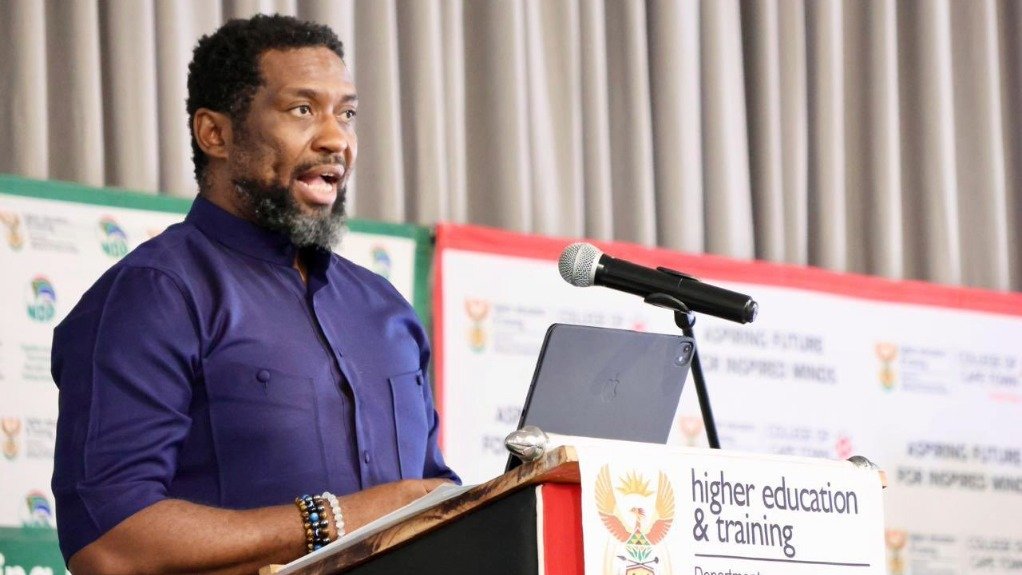


Minister of Higher Education and Training Buti Manamela on Thursday stressed the importance of vocational education in the country’s post-school system, stating that technical and vocational education and training (TVET) and community colleges are not residual options.
Manamela was briefing the media on the post school education and training (PSET) sector’s plans for the 2026 academic year as well as the state of readiness.
He said the PSET system had about 535 000 funded and planned spaces across universities, TVET colleges, community colleges, skills programmes and workplace-based learning.
Manamela told media that South Africa’s post-school system must be differentiated, articulated, but also well-communicated, as he noted a stagnant performance in mathematics and accounting.
The Matric Class of 2025 achieved the highest pass rate in the country’s history, achieving a pass rate of 88% - an improvement from 87.3% in 2024.
Manamela noted that 46.4% of candidates achieved a bachelor's pass, 28.1% achieved a diploma pass and 13.5% achieved a higher certificate pass.
He noted that this meant that over 40% of learners did not achieve a bachelor's pass, noting that even such a pass did not guarantee entrance into a university.
Manamela said the country’s post-school system was deliberately designed to be differentiated with universities, TVET colleges, community colleges, occupational qualifications, skills programmes, and work-based learning all forming part of the system.
“And so when people look up to our system, it should not just be that we want to go to universities. When people look up to our system, it must be that I either want to pursue an academic or a vocational stream or a hybrid of those streams. And so choose on the basis of what is available out there in terms of this particular stream. And they are provided across all of our institutions,” he explained.
His department wants to strengthen coordinated enrolment planning across the education system, linking with basic education.
He explained that the newly established just energy transition skills desk would play a critical role in linking demand to priority economic sectors, particularly renewable-energy construction, grid infrastructure, and electric mobility.
He said given the infrastructure and staffing constraints, the department would increasingly prioritise short courses and modular qualifications, particularly at TVET colleges and community colleges.
The department wants to encourage the growth of occupational programmes that can be scaled up speedily.
Manamela explained that this was the first year the department was rolling out its occupational programme on a large scale. The programme included apprenticeships, learnerships, and internships, which would be the emphasis of the education and training authorities.
“[That is] three pathways which offer faster labour market entry while allowing articulation into further learning. So if you could not get a spot at university, it does not mean that it is the end. We have all of these options and we encourage learners together with their parents to look for and find these opportunities; your TVET colleges, as I said, community colleges,” he stressed.
CONSTRAINTS
Meanwhile, Manamela said his department viewed science, technology and engineering under-representation as a major constraint confronting the PSET system.
He said the current trend of growing enrolment in mathematical literacy rather than pure mathematics was concerning, as there was stagnant performance in mathematics and accounting, and limited growth in physical sciences.
The consequences are very profound, he stated.
“Learners are excluded from high-demand programmes in engineering, health sciences, ICT, data science, and also advanced manufacturing, not because of institutional failure, but because of subject-level preparation,” he explained.
This weakened the country’s national skills base and limited the system's responsiveness to industrialisation, innovation, but also to economic growth, he expanded.
He said the Department of Basic Education and the Department of Higher Education and Training were strengthening alignment, particularly around subject choice, guidance, learner preparedness, and also smoother transitions into post-school science, technology, engineering and mathematics programmes.
Article Enquiry
Email Article
Save Article
Feedback
To advertise email advertising@creamermedia.co.za or click here

Projects


Latest Multimedia
Latest News


Showroom

As a reticulator, Egoli Gas provides natural gas to homes and businesses via underground pipes.
VISIT SHOWROOM
Axiom Hydraulics is a trusted leader in South Africa’s hydraulic industry, delivering world-class components, systems, and engineering expertise...
VISIT SHOWROOM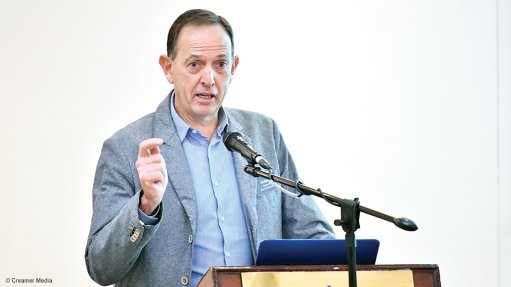
Press Office
Announcements
What's On
Subscribe to improve your user experience...
Option 1 (equivalent of R125 a month):
Receive a weekly copy of Creamer Media's Engineering News & Mining Weekly magazine
(print copy for those in South Africa and e-magazine for those outside of South Africa)
Receive daily email newsletters
Access to full search results
Access archive of magazine back copies
Access to Projects in Progress
Access to ONE Research Report of your choice in PDF format
Option 2 (equivalent of R375 a month):
All benefits from Option 1
PLUS
Access to Creamer Media's Research Channel Africa for ALL Research Reports, in PDF format, on various industrial and mining sectors
including Electricity; Water; Energy Transition; Hydrogen; Roads, Rail and Ports; Coal; Gold; Platinum; Battery Metals; etc.
Already a subscriber?
Forgotten your password?
Receive weekly copy of Creamer Media's Engineering News & Mining Weekly magazine (print copy for those in South Africa and e-magazine for those outside of South Africa)
➕
Recieve daily email newsletters
➕
Access to full search results
➕
Access archive of magazine back copies
➕
Access to Projects in Progress
➕
Access to ONE Research Report of your choice in PDF format
RESEARCH CHANNEL AFRICA
R4500 (equivalent of R375 a month)
SUBSCRIBEAll benefits from Option 1
➕
Access to Creamer Media's Research Channel Africa for ALL Research Reports on various industrial and mining sectors, in PDF format, including on:
Electricity
➕
Water
➕
Energy Transition
➕
Hydrogen
➕
Roads, Rail and Ports
➕
Coal
➕
Gold
➕
Platinum
➕
Battery Metals
➕
etc.
Receive all benefits from Option 1 or Option 2 delivered to numerous people at your company
➕
Multiple User names and Passwords for simultaneous log-ins
➕
Intranet integration access to all in your organisation